Sensory Ability

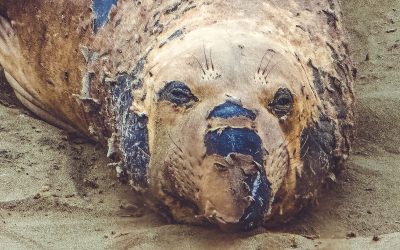
Elephant seals forage at great depth where it is very dark, even during the day. While there is no evidence of any echolocation ability, foraging appears to depend upon vision and sensitivity of their whiskers – vibrissae.

The sensitivity of their eyes to light is ten times that of a human and is particularly sensitive to the colors of their bioluminescent prey.  Like cats, they have a reflecting surface behind the retina, which roughly doubles their sensitivity. Their eyes permit clear vision both in water and in air. The powerful lens of their eye is responsible for most of the focusing, rather than the cornea. In addition, it takes only 2-3 minutes for elephant seals to adapt their vision from the bright ocean surface to the dark conditions at the bottom of their dive.  In comparison, it would take humans 25 minutes to adapt to the same dark conditions.

Their elephant seal’s vibrissae pick up underwater vibration and tactile cues that contribute to successful foraging. The sensory information from the extensive neural connections at the base of each whisker help them to focus on and follow prey.  Each of the approximately 100 whiskers on both sides of the face can sense the location of moving prey.

The whiskers may be a millimeter across (roughly 10 times the width of human hair) near the face.  They arise from follicles that can be 3⁄4 “ long, much longer than the follicles in samples of molted hair.  They have 5 to 10 time as many nerve endings as terrestrial mammal whisker follicles.

Each whisker has a blood supply as well, which helps to avoid the numbing effect of cold waters and to furnish the many nerves with needed oxygen. The whisker follicles are supplied with enough blood that even the skin around them is a few degrees warmer than the rest of the face.

Where Can Elephant Seals Be Found?

Northern elephant seals are found in the North Pacific, along the coast of North America, from Baja California, Mexico to the Gulf of Alaska and Aleutian Islands. During the breeding...

read more

Birthing and Breeding

Birthing and breeding season takes place December through March. Adult male seals (bulls) and large sub-adult male seals begin to arrive in late November, with most arriving in December....

read more

Delayed Implantation

Shortly before a female leaves the rookery after birthing and nursing her pup, she will mate several times and become pregnant. She leaves the rookery for two to three months, returning in...

read more

Fasting

Except for nursing pups, all of the seals in the rookery are fasting – no food and no water for their entire stay. They survive by metabolizing their blubber, providing energy,...

read more

Sonification

A recent study produced some results and a presentation that is very interesting. Data on the tracking of 321 adult female seals were used to produce a “chorus” that captured some...

read more

Age Classes

Northern elephant seals can be categorized into multiple classes based on their age and gender. Females mature earlier than males and reach adulthood several years before males do.Pup =...

read more

Making Energy from Blubber

Elephant seals have a thick layer of blubber that keeps them warm in the deep, cold sea. Blubber is fatty tissue found under the skin in all pinnipeds. Blubber is different from other...

read more

Thermoregulation

Seals control internal temperatures and reduce heat loss by a mechanism called countercurrent heat-exchange.  As an example, the arteries carrying warm blood to the hind flippers...

read more

Oxygen Capacity and Utilization

Oxygen is used by all mammals to support metabolism and is carried in three ways - as a component of air in the lungs, attached to hemoglobin in the red blood cells, or attached to...

read more

Lifespan of an Elephant Seal

As with most wild animals, an elephant seal’s life is fraught with danger. As visitors to the rookery can see during the birthing season, a number of seal pups do not survive. High seas...

read more

Molting

Beginning in late March and extending into September, each of the seals, with the exception of the weaned pups of that year, will return to the rookery for a month to grow new skin and...

read more

The Dive Response

Like all seals, elephant seals undergo a set of physical changes when they dive – called the dive response. The dive response includes a significant drop in heart rate, constriction of...

read more

Get the Latest News & Updates

Donate

Friends of the Elephant Seal is a 501(c) (3) non- profit corporation, relying on grants, sponsorships, memberships and your donations. Your charitable contribution supports our programs.

Sign Up for E-mail Updates

Be among the first to receive updates, photos, events and more about the Piedras Blancas northern elephant seal colony. The Friends of the Elephant Seal does not share your personal information with outside advertisers or other organizations.

Follow Us

Follow Friends of the Elephant Seal on our social channels for up-to-the-minute updates and images from the rookery.

Friends of the Elephant Seal is a cooperating association with California State Parks.

Translate »